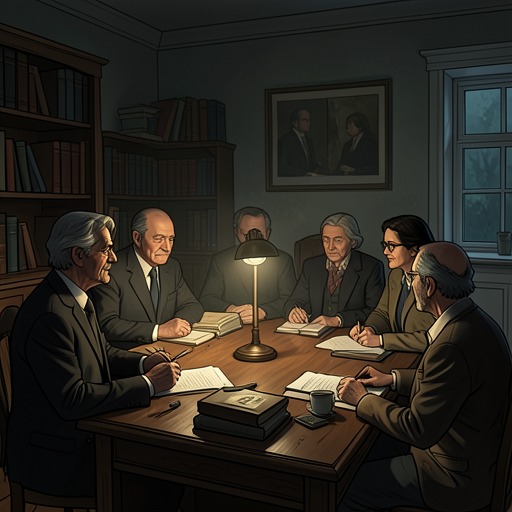
Isaac Folkoff
American PrometheusIsaac Folkoff was a veteran Communist Party of California organizer whose work as a Bay Area fundraiser brought him into contact with J. Robert Oppenheimer and his brother Frank. He collected Oppenheimer’s cash contributions for political causes, first through a chain that began with aid to the Spanish Republic and later for farm-worker organizing. That role made Folkoff a concrete link between Oppenheimer’s progressive commitments and the party connections that became consequential under FBI surveillance and later scrutiny of Oppenheimer’s past.
Identity and Political Work
By the time he met Oppenheimer, Folkoff was in his late seventies, a former garment worker with one paralyzed hand. He headed the Communist Party of California’s finance committee in the Bay Area. His standing among local left-wing organizers rested not on a prominent public office but on the trust he had earned among professionals around the movement. Steve Nelson, who became the San Francisco party chairman in 1940, recalled Folkoff as a respected veteran of the left who had worked as a laborer, developed an interest in philosophy, and acquired a reputation for dignity and reliability. That reputation made him a practical collector of contributions from people whose professions and resources differed from his own.
Folkoff’s political role appears in the account chiefly through this financial work. He was neither the originator of Oppenheimer’s interest in Spanish relief nor its public spokesman: Thomas Addis first approached Oppenheimer for donations, and later suggested that regular contributions could be routed more conveniently through Folkoff. The change in intermediary placed Folkoff at the point where a private donor’s money entered party channels, while leaving the purposes and eventual uses of the funds partly outside the donor’s view.
Collecting Oppenheimer’s Contributions
Oppenheimer had already become sympathetic to the Spanish Republic when Addis asked him to contribute. Addis urged him to send money through Communist channels, arguing that it would do more good there. Oppenheimer thereafter made regular cash payments in person, usually in Addis’s laboratory or at his home. After a time, Addis proposed that Folkoff collect them instead. The narrative does not specify the date of the handover or describe a particular meeting between Folkoff and Oppenheimer; it establishes the arrangement and the payments, not a scene of their negotiation.
The contributions were substantial for the period: Oppenheimer’s annual donations for Spanish relief through the Communist Party amounted to about $1,000. He understood that the money was intended to go directly to the fighting effort. His choice of cash reflected his concern that contributing to military equipment, unlike providing medical aid, might not be entirely legal. The arrangement therefore joined a humanitarian and anti-fascist commitment to a materially consequential form of support, while also carrying a legal uncertainty that helped explain why the payments were not made openly by ordinary means.
After the Spanish Republic’s defeat in 1939, Addis and then Folkoff solicited contributions for other causes, including the party’s efforts to organize California’s migratory farm workers. Oppenheimer’s last known contribution through this route appears to have been made in April 1942. Nelson also confirmed that Folkoff collected money from Frank Oppenheimer. The evidence thus connects Folkoff to both brothers’ financial support, although it does not establish that every contribution had the same purpose, amount, or timing.
Surveillance and Uncertain Party Ties
Folkoff’s fundraising brought him into the FBI’s field of view before the Bureau opened its file on Oppenheimer. For almost a year, agents had been wiretapping the conversations of Folkoff and William Schneiderman, the California party’s state secretary. The wiretaps lacked authorization from a court or the Attorney General. In December 1940, an agent heard Folkoff refer to a 3:00 p.m. appointment at Haakon Chevalier’s house as a meeting of the big boys. An agent noted the license plates of cars outside; one belonged to Oppenheimer. The chance observation helped lead the FBI to investigate Oppenheimer, whose name had otherwise come to the Bureau’s attention by accident.
That episode documents why Folkoff’s political network mattered to investigators, but it does not prove the FBI’s broader suspicions about Oppenheimer. A separate, undated document in Oppenheimer’s file purported to list members of a Communist Party professional section, including Folkoff, Addis, Chevalier, and Oppenheimer. The document’s credibility cannot be evaluated from the surviving material described here. The presence of a name in that list is therefore evidence of what investigators received, not conclusive evidence that the listed group existed as described or that every named person held the same formal status.
Chevalier later described an unofficial discussion group of academics that he said included Oppenheimer. In his account, members paid dues to the party, with Oppenheimer paying separately; Chevalier speculated that he may have contributed more than the expected amount. Oppenheimer, by contrast, consistently maintained that he gave money to causes but never paid party dues. Chevalier’s recollections also left the group’s standing ambiguous: he described political commitment and financial support but denied that it took party orders. These accounts do not establish Folkoff’s precise role in such a group. They do, however, show how the documented flow of contributions through him existed alongside unresolved claims about the formality of Oppenheimer’s party affiliation.
Later Significance
When questioned about his Communist Party donations in 1954, Oppenheimer said he doubted that he had considered whether the money might be redirected to purposes beyond those he intended, or whether such purposes might be evil. He explained that he had not regarded Communists as dangerous and had considered some of their declared aims desirable. Folkoff’s place in the account gives that retrospective explanation a practical dimension: Oppenheimer had made significant contributions through a party finance official, but his stated understanding centered on the causes he meant to support.
Folkoff’s significance in the biography is consequently specific but substantial. He appears as a trusted collector in the networks through which anti-fascist and labor causes received money, and as a person whose monitored conversations helped draw the FBI toward Oppenheimer. The evidence does not make Folkoff responsible for the later security case, nor does it settle the disputed question of Oppenheimer’s formal party membership. It shows instead how fundraising, political association, and unlawful surveillance could converge: an appointment at Chevalier’s house, observed through a wiretap on Folkoff, turned a local network into material in the government’s long scrutiny of Oppenheimer.